New music in a forgotten genre
By the time the old wires quit humming and the towns learned again to listen by porchlight, The Scrips had already left a fair trail through East Texas: chapel rooms, farmers markets, coffee houses, barbecue joints, art festivals, breweries, old theater bills, and handbills enough to paper a feed-store wall.
“The lyrics grabbed. And I am a sucker for the minor G dirgy-kind of songs.” Max Stalling, Shiner Rising Star judge
A contrary little outfit
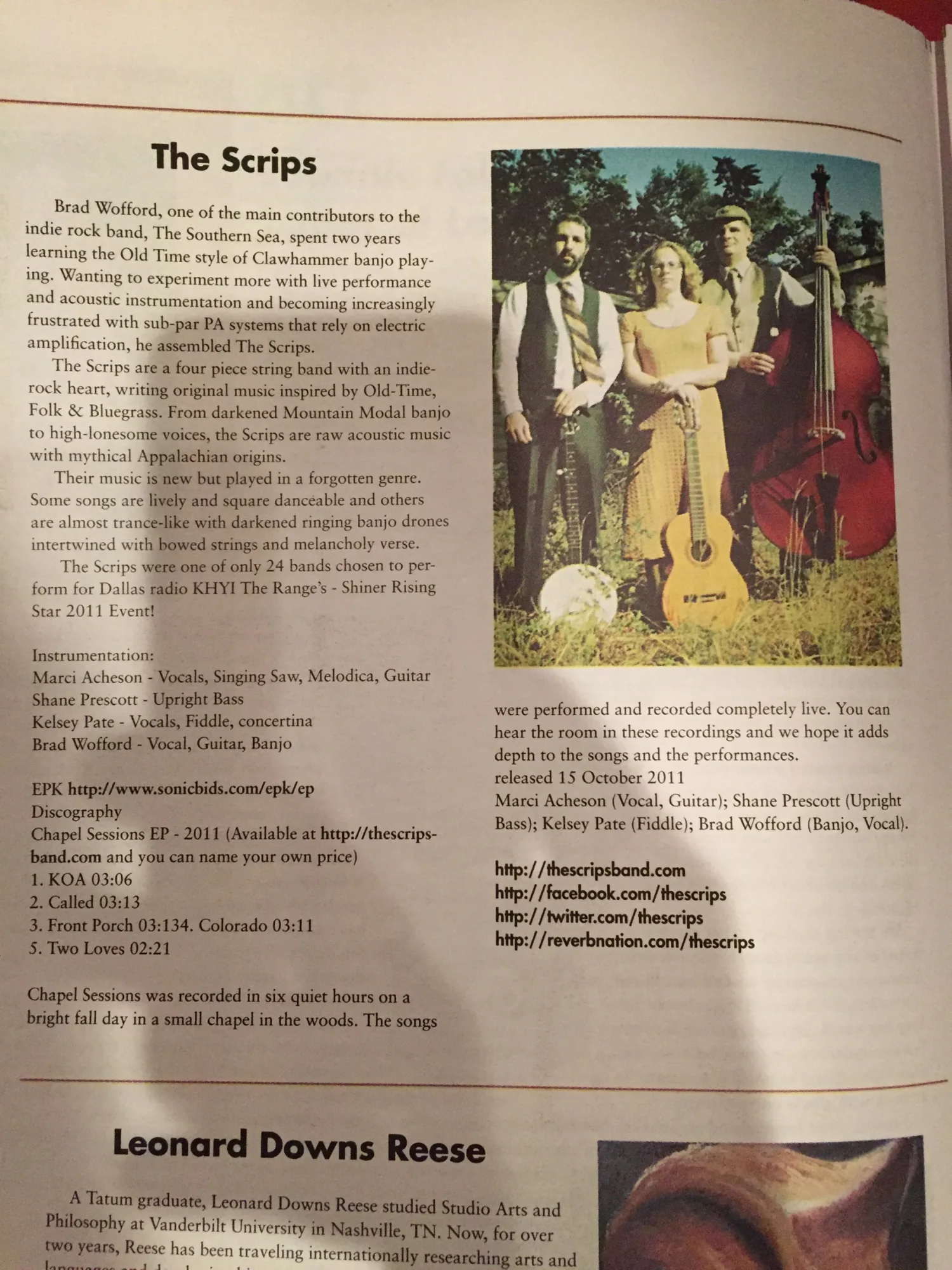
The record does not give us a single grand founding date. Bands rarely begin that cleanly. They gather by weather, friendship, frustration, and a sound somebody cannot quite shake. In this case, the sound began around Brad Wofford, who had come out of the indie-rock country of The Southern Sea and spent a couple of years teaching his hands the old-time way of clawhammer banjo. The electric world, with its bad rooms and worse public address systems, had started to feel like too much machinery between the song and the listener. So The Scrips were assembled as a contrary little outfit: acoustic first, raw by design, and carrying what their own papers called “an indie-rock heart.”
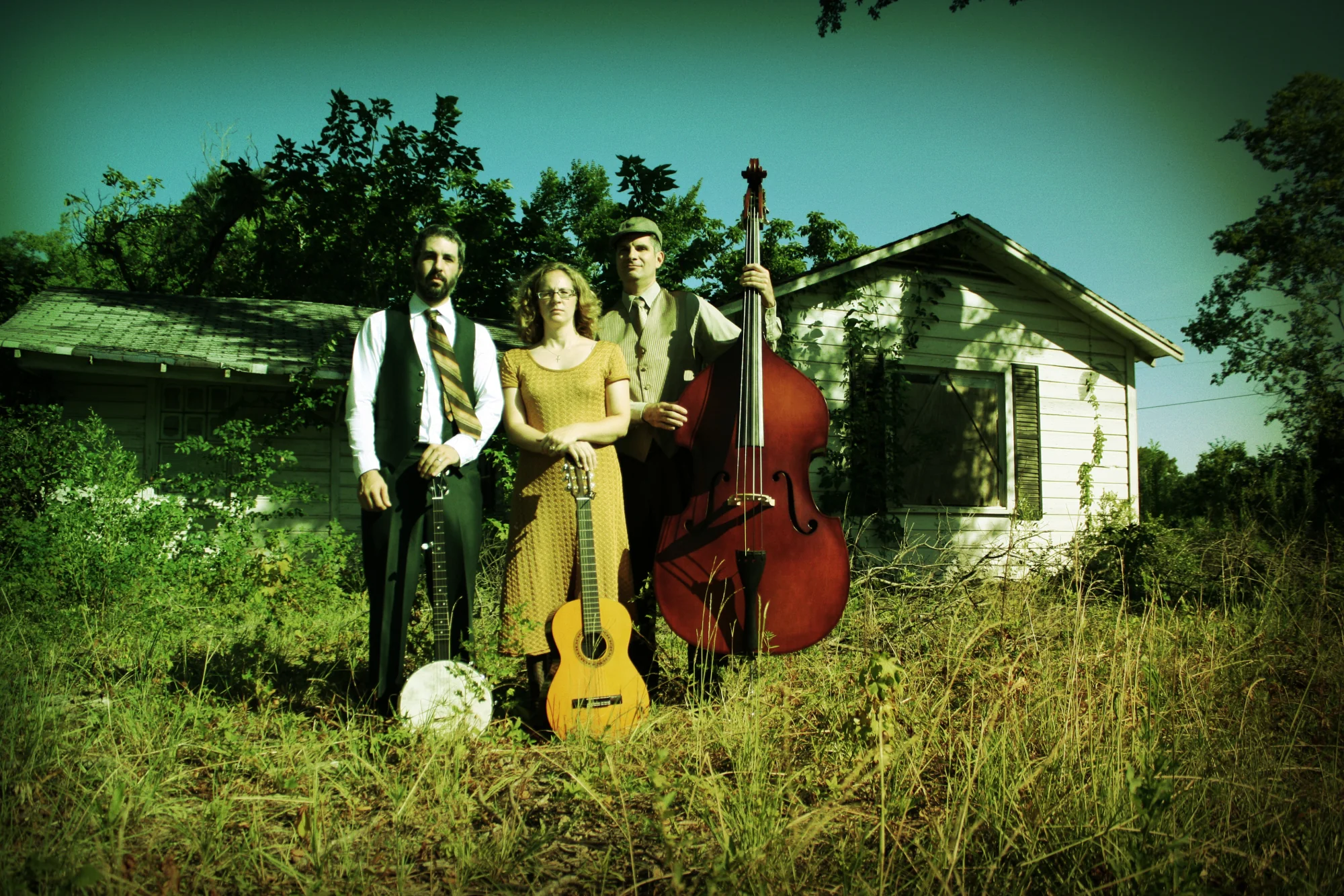
The early public shape of the band is best documented in 2011. Brad Wofford stood at the center with banjo, guitar, voice, songs, and design work. Marci Acheson brought voice, guitar, melodica, and singing saw. Kelsey Pate carried fiddle, concertina, and voice. Shane Prescott held the upright bass. In those first documents, The Scrips were described as a four-piece string band writing original music inspired by old-time, folk, and bluegrass. The language around them was already a little haunted: dark mountain-modal banjo, high-lonesome voices, bowed strings, melancholy verse, lively square-dance motion, and new songs played in a forgotten genre.
The first trail markers
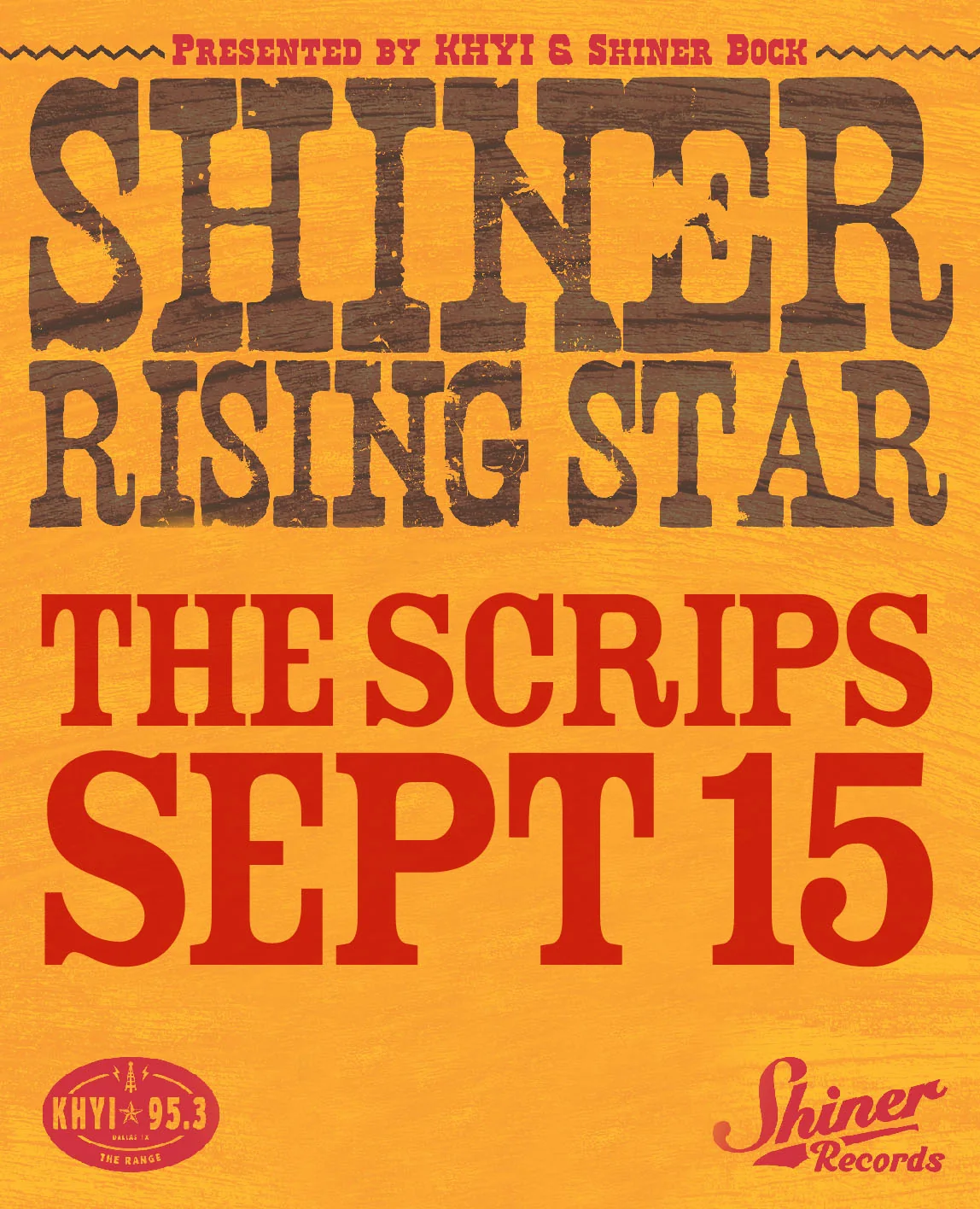
The first dated trail marker in the gig log is July 4, 2011, at YWAM / Living Alternatives / Fatherheart. By September the band had made enough racket, and the right kind of racket, to be chosen as one of only twenty-four bands for the 2011 Shiner Rising Star event tied to KHYI 95.3 The Range and Shiner Beer. The notes from that period make a point of the instrumentation: banjo, guitar, bull bass or upright bass, melodies and harmonies that did not need much explaining. There was even talk that the music sounded like it belonged in old western pictures, which may be the nearest thing the archive offers to a prophecy.
Six quiet hours in a chapel
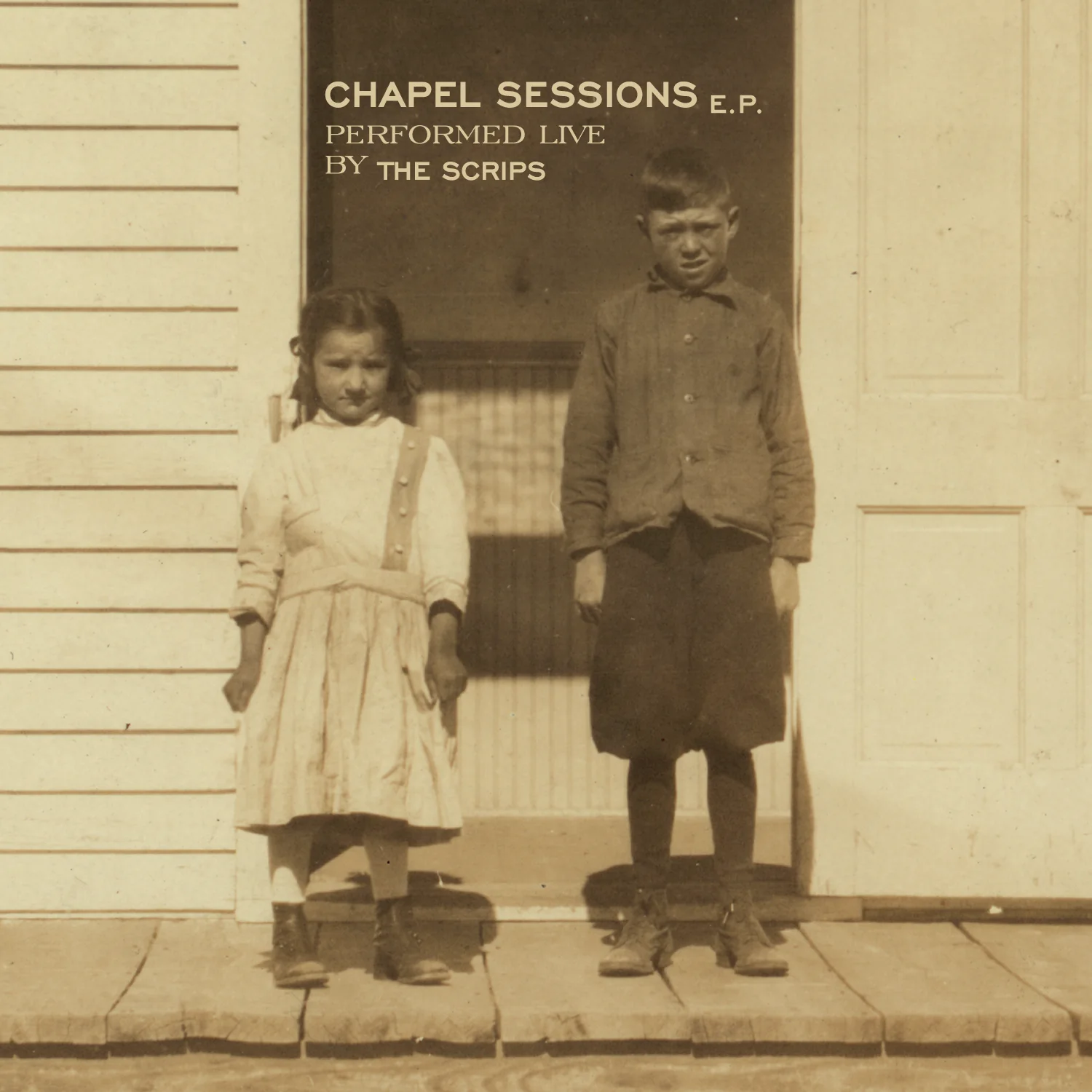
That same fall, The Scrips walked into a small chapel in the woods near Flint, Texas and recorded what became the Chapel Sessions EP. The papers say it plainly: September 2011, six quiet hours, completely live. No glass tower, no gloss, no great studio machinery. Just the room, the instruments, and five Brad Wofford songs: “KOA,” “Called,” “Front Porch,” “Colorado,” and “Two Loves.” The EP was released October 15, 2011. Josh Evans engineered and mastered it, and the credits place Marci on vocal and guitar, Shane on upright bass, Kelsey on fiddle, and Brad on banjo and vocal. The cover was designed by Brad using a Library of Congress photograph, which fits the whole enterprise: something handmade from the past, repurposed for a new local noise.
The EP moved through the online frontier of its day: SoundCloud, ReverbNation, NoiseTrade, Bandcamp. By late October 2011, “Front Porch” was being pushed as track three from Chapel Sessions. By November, the EP was circulating as a free or name-your-price release. The Scrips were not yet a big band, but they were already leaving evidence.
The map widens
In 2012, the map widens. The band turns up at New Mojoe’s in Henderson, Rick’s in Tyler with Breathe Owl Breathe and The Magills, Liberty Theater, Rusty Shovel, Bridge 281 in Longview, Edom Arts Festival, and the Coffin Shop. The year also brings one of the archive’s clearest lineup clues: Robert Finney appears in the record as a Scrips member and is named in Facebook screenshot notes as joining rehearsal on upright bass in July 2012, playing Mojoe’s later that month, and being publicly described in August as the band’s new upright bass player. Brad later confirmed Robert’s place plainly: upright bass and vocals.
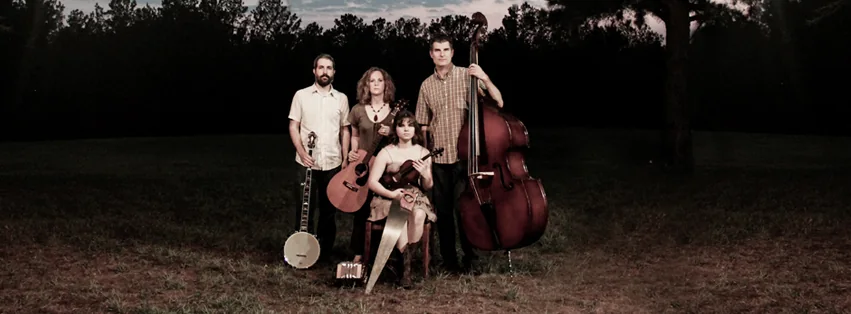
Sparse Mountain Folk
By 2013 the band had become a working East Texas concern. There was a 99.3 radio appearance on the Terry Miller Morning Show, a show with Aaron Lee Martin at The Vineyard, a Dallas date opening for Pokey LaFarge at The Prophet Bar, dates at The Forge in Ben Wheeler, Stanley’s, and the recurring July 4 orbit. The posters from this era carried their own weather. The band leaned into “Sparse Mountain Folk,” a phrase that sounds less like a genre and more like something written on a crate after the train quit running. That year also brought public videos, cover songs, new originals, and talk of a next record. There were private parties with cicadas and string lights, radio clips, barbecue posters, and Kelsey Pate explaining the musical saw on video.
In 2014 The Scrips stretched again. The gig log places them at Deep Ellum Big Folkin’ Festival, True Vine, another July 4 date, Illusions & Bluegrass, Hoptoberfest, and The Foundry. Gabriel Clayton, or Gabe, came after Robert and before Stevie, carrying hammered dulcimer into the band and adding another strange and ringing color to the Scrips table. Around the same time, the record mentions live-streamed rehearsals, Buzz Local Radio, a growing Facebook following, and experiments with a vintage Nagra III tape recorder: one microphone, straight to tape, searching for the right room. It is hard to imagine a more Scrips sentence than that.
“One microphone, straight to tape, searching for the right room.”
Reasons to return
The middle years, 2015 through 2017, read like the life of a band that kept finding reasons to return to the stage. Farmers markets. Music in the Park. The Forge. Edom Art Fest. The Beatles Tribute Show. True Vine. Stanley’s. Vintage Edom. The Joy of Sight. Hoptoberfest. The vocabulary shifted a little too: lo-fi indie bluegrass, bluegrass and gothic Americana, five-piece string band. Stevie came after Gabe, bringing fiddle, viola, guitar, and vocals into the band story.
This period also produced some of the strongest later creative signals: a rehearsal video of “Hard Times,” work with Yellow Dog Studios, plans for music video and original-song releases, and the Scrip-O-Phone limited release in Edom in 2017. “Marybelle” became a video project. “Rice Queen” moved toward the wider digital world. By 2018, “Rice Queen” was on Spotify and Apple Music, written out of Bay City and the Rice Festival country. By 2019, the public notes claimed nine recorded originals, eight free downloads, and four streaming singles.
The quiet in the papers
Then the trail thins, as band trails sometimes do. The gig log has later marks: Rose City Farmers Market in 2019, True Vine in 2021. After that, the papers go quiet for a while, but they do not end.
The new return
In the new return, The Scrips come back looking less like a nostalgia act than a band picking up its own tools. The current lineup is Brad Wofford on clawhammer banjo, guitar, and vocals; Marci Acheson on guitar and vocals; Shane Prescott on upright bass; and Kelsey Lepley on fiddle, concertina, musical saw, and vocals. The 2026 archive points to Edom Art Walk on June 14, a KETK Hometown Harmonies session on June 17, Make Music Day Tyler at ETX Brewing on June 21, a June Apple video on June 29, The Forge in Ben Wheeler on July 4, Noonday Farmers Market on July 11, and an August podcast session with songs and talk. The working sound is still what the old papers promised: clawhammer banjo, fiddle, guitar, upright bass, close voices, hymns, fiddle tunes, originals, public-domain fragments, and the occasional instrument that sounds like it was found in a cabinet after the county records burned.
The modern live set keeps both halves of the band in view. There are old-time pieces like “June Apple,” hymns and folk standards, and Scrips originals such as “KOA,” “Called,” “Front Porch,” “Colorado,” “Two Loves,” “Marybelle,” “Ship and Anchor,” “Rice Queen,” “St. Augustine,” “Time,” and “Let’s Get the Band Together.” Some songs are built for motion. Some are built for dusk. The best ones seem to believe those are not opposites.
The same argument
So the short history is this: The Scrips began as an acoustic rebellion against bad electricity and thin rooms, became a documented East Texas string band in 2011, recorded a live chapel EP, played the towns and festivals and odd corners where a band earns its manners, widened its sound through upright bass, fiddle, saw, concertina, dulcimer, guitars, banjo, and voices, left behind a handsome paper trail of posters and set lists, went quiet without disappearing, and returned still carrying the same argument.
The argument is simple enough. A song can survive without polish. A room can be part of the recording. A local band can carry older American forms without embalming them. And if the lights go out, The Scrips may be better prepared than most.
“Some songs are built for motion. Some are built for dusk.”